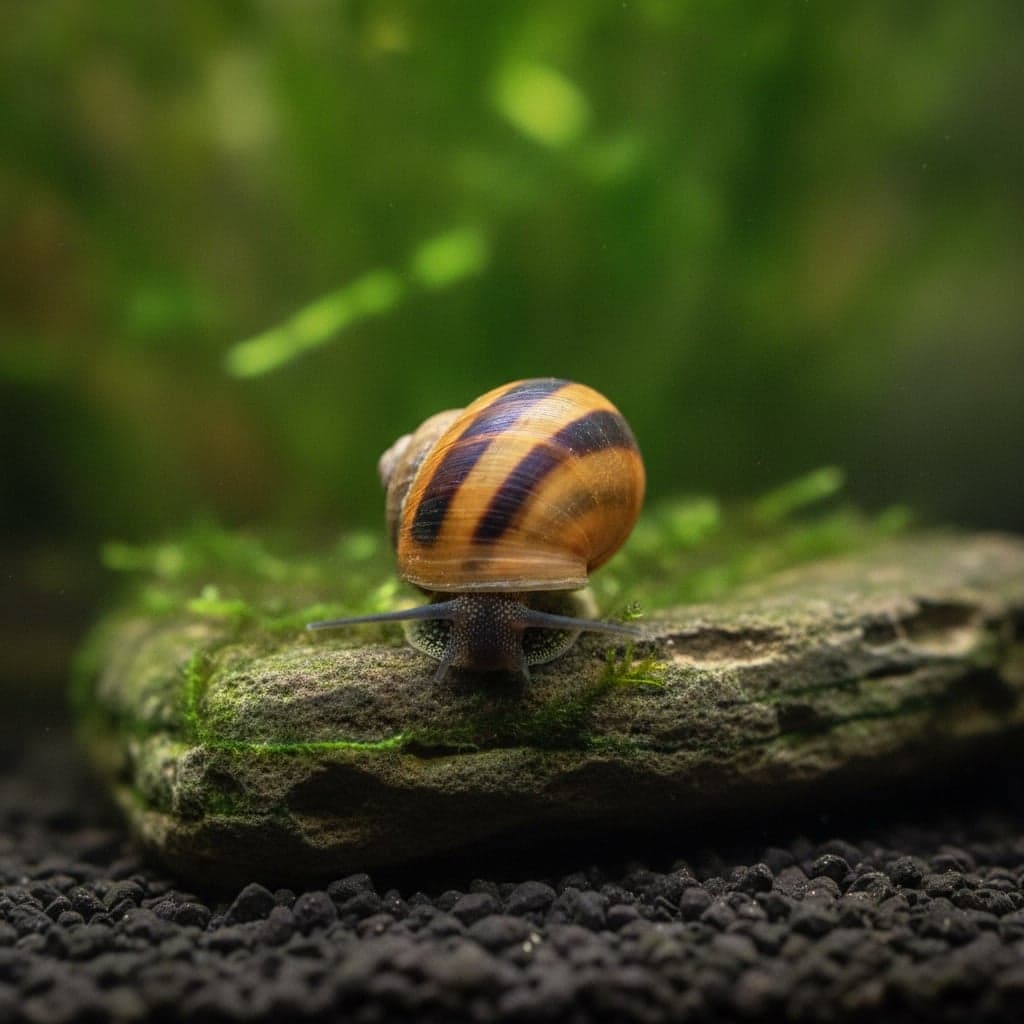
Black Military Helmet Nerite Snail: Neritina pulligera
The largest commonly kept nerite, with a heavy dark shell shaped like a helmet. Its size lets it clear algae from glass faster than any other nerite.
Also known as: Military Helmet Snail · Black Helmet Snail · Neritina pulligera

Black Military Helmet Nerite Snail
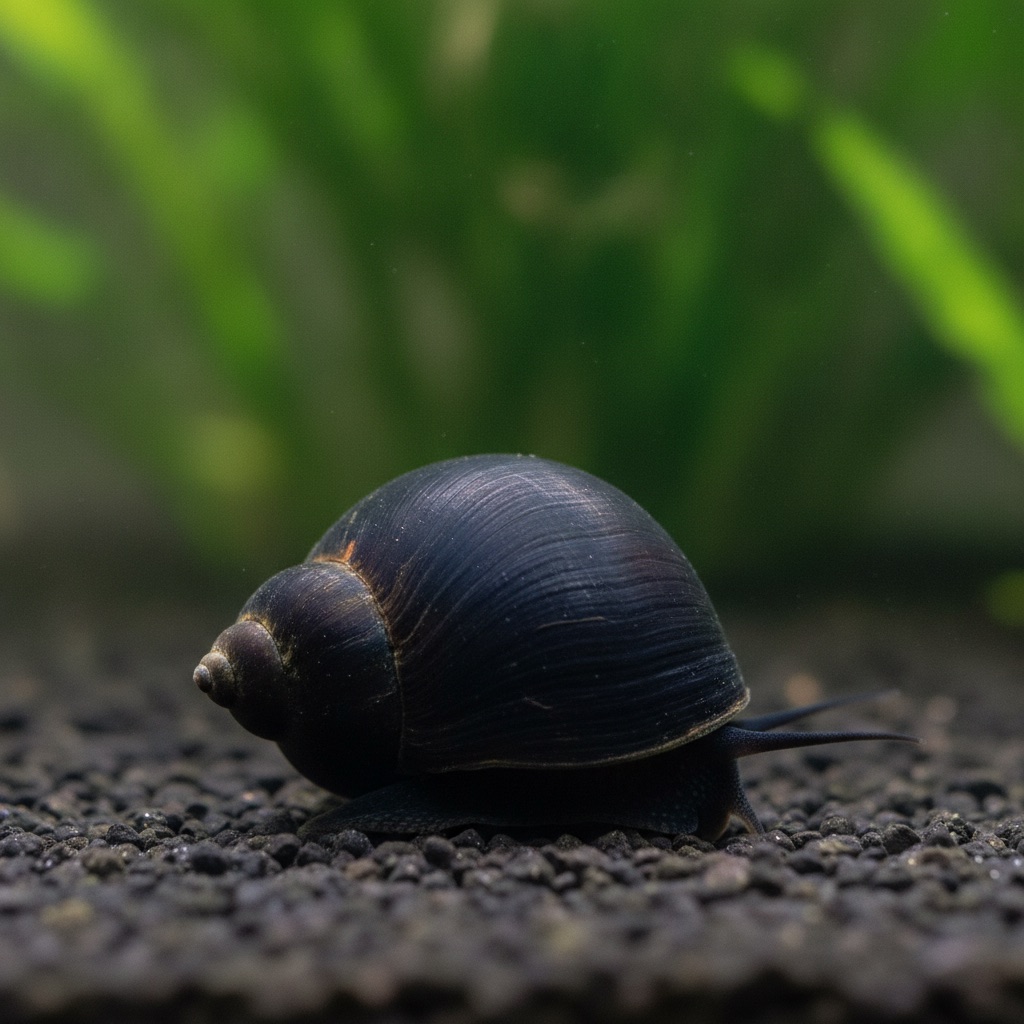
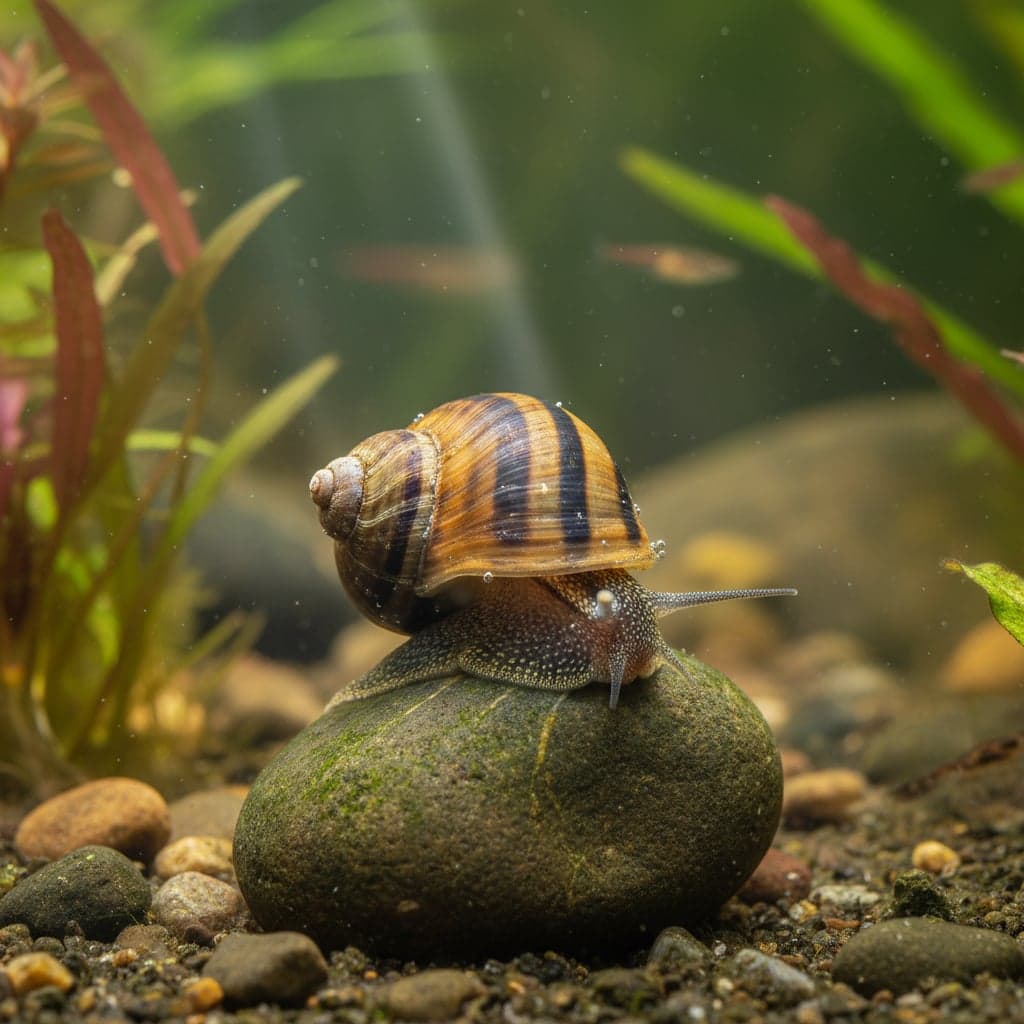
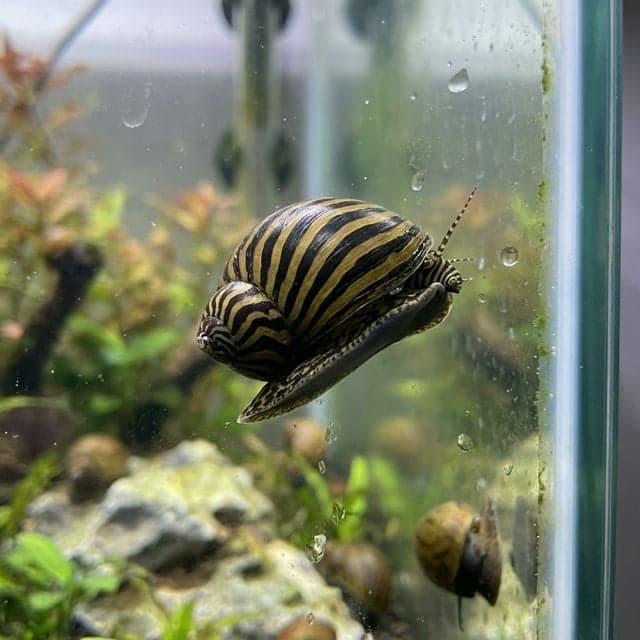
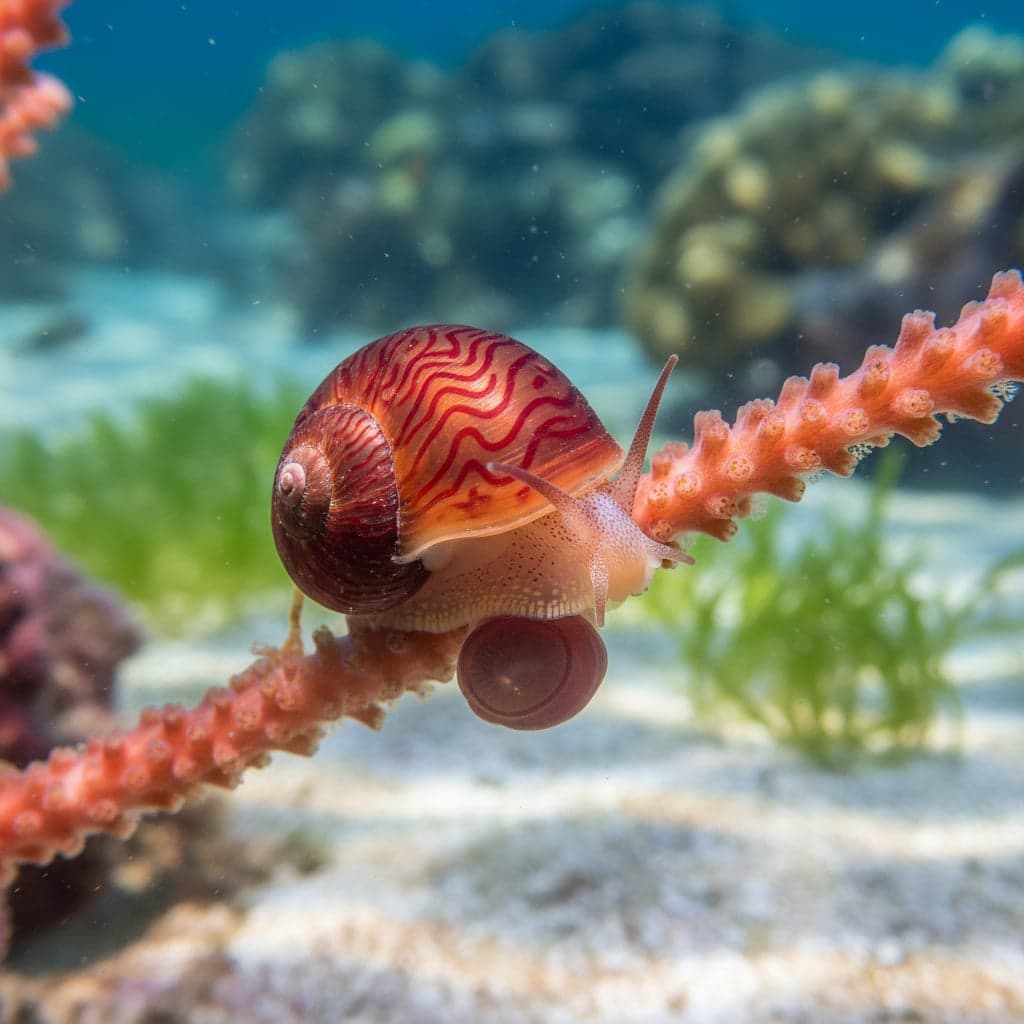
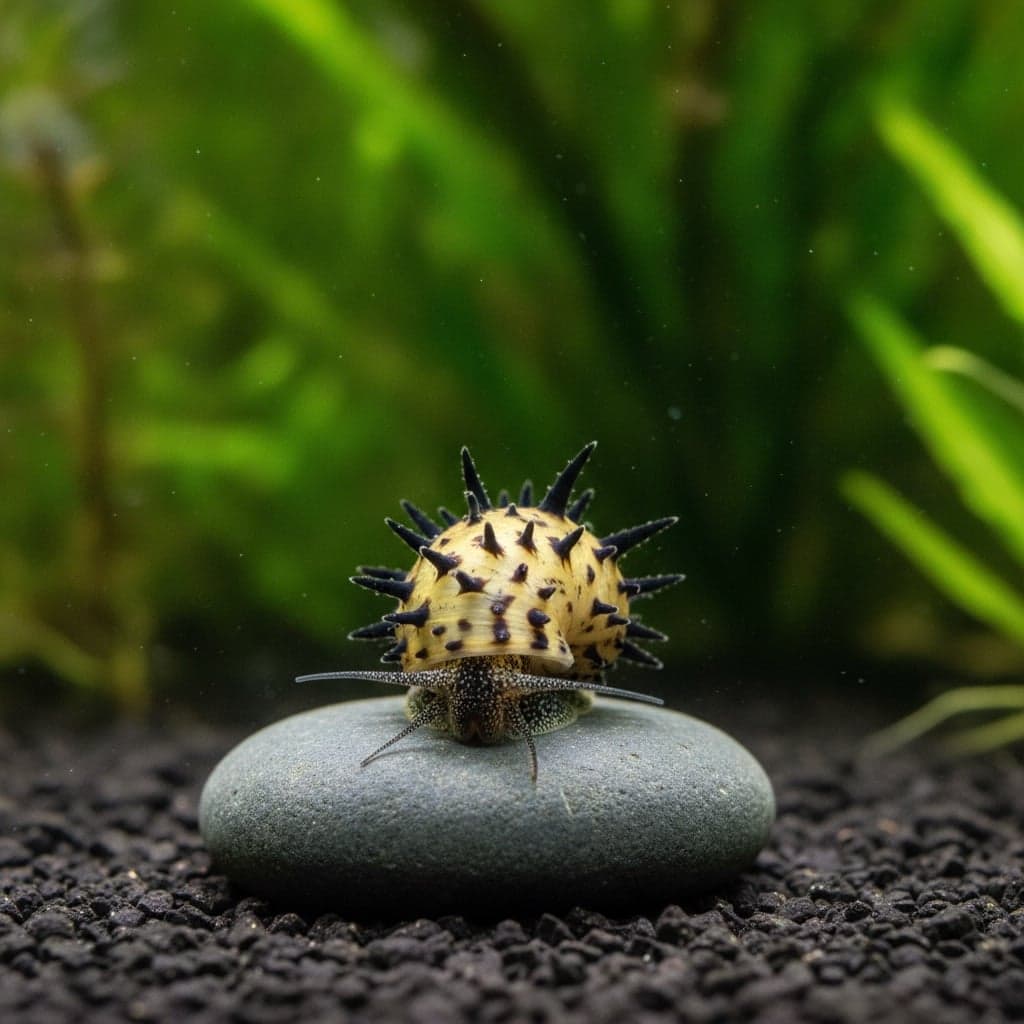
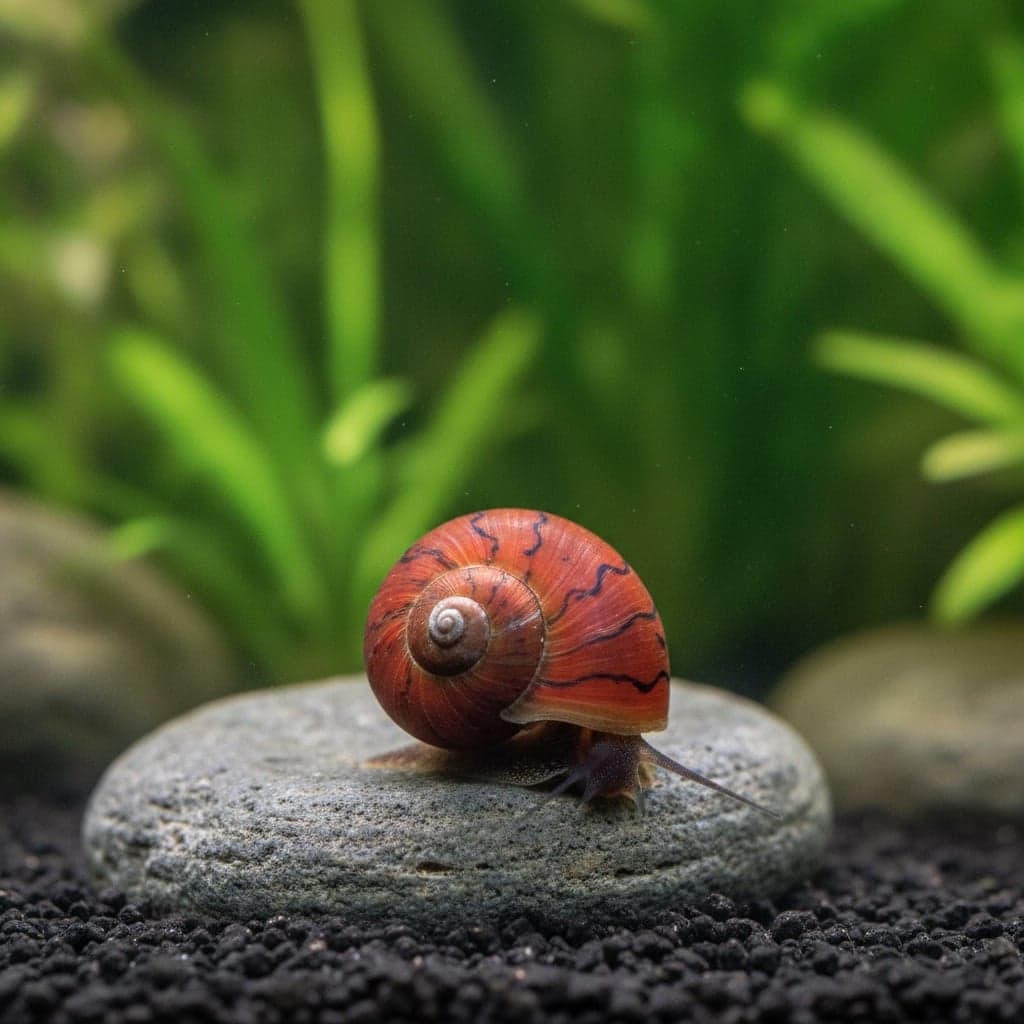
At 3 to 4 cm across, the Black Military Helmet is roughly three times the shell area of a zebra nerite and it does the work to match. The shell is a smooth, heavy dome in near-black or dark olive-brown, sometimes with a faint radial banding that only shows in direct light, and the aperture is a broad white plate. It looks like a piece of hardscape until it moves.
Size changes the arithmetic in three ways. It clears glass faster than any other nerite, because grazing rate scales with radula width. It needs more calcium, because the shell it maintains is heavier. And it eats more, which means it runs out of food sooner in a tank that cannot sustain it — a single helmet nerite will outstrip a 40-litre tank's algae production within a fortnight.
Natural Habitat & Origin
Neritina pulligera has one of the widest ranges of any freshwater snail, running from East Africa and Madagascar across the Indian Ocean islands to Southeast Asia, New Guinea and Polynesia. It lives in fast-flowing coastal streams and the lower reaches of rivers, clamped to boulders in current strong enough to sweep an unattached snail away. That habitat explains the shell shape: a low, smooth dome offers minimal drag, and the broad muscular foot holds like a suction cup. If you struggle to lift one off the glass, that is the adaptation.
Its life cycle is amphidromous like the rest of the family. Adults live in fresh water; larvae drift down to the estuary, feed as plankton in brackish water for several weeks, then settle and climb back upstream. Every animal in the trade is wild-collected from that adult population, because nobody runs the brackish larval phase commercially.
Care Requirements
The hardness requirement is the same as other nerites in kind but larger in degree. A shell this heavy represents a lot of deposited calcium carbonate, and in soft or acidic water the chemistry works against it continuously: below about 6 dGH the water is undersaturated with respect to aragonite and dissolves the shell faster than the snail replaces it. Target GH 8-14, KH 4 or more, and pH held above 7.0. In soft tap water, use crushed coral in the filter or a remineraliser — not a pH-adjusting chemical, which raises the reading without adding the carbonate that keeps it up. See GH, KH and hardness.
Give it space to work. A tank of 40 litres or more is a sensible floor, and the real constraint is surface area rather than volume: a long tank with plenty of rock and driftwood supports it far better than a tall one of the same capacity.
This is the one nerite that is less inclined to climb out, partly through weight and partly through temperament, but the lid rule still applies — they graze the waterline band and occasionally keep going. The mass is also worth planning around: a 4 cm snail with that grip will shift an unsecured plant or topple a loosely stacked rock while feeding, so glue or wedge anything precarious.
Use the Aquarium Tracker to log these parameters against your own readings — it flags a drift before it becomes a problem.
Diet & Feeding
Film algae, diatoms, green dust and biofilm, taken off glass, rock and wood with a broad radula that clears a wider track per pass than any other nerite in the hobby. It handles green spot algae competently, though the olive nerite is the specialist there. Like all nerites it ignores hair algae and black beard algae — do not buy one to solve either.
Then feed it. This is not optional with a snail this size. Its efficiency means that in most tanks it eliminates the standing algae within two or three weeks and then depends entirely on you: algae wafers, blanched courgette, spinach or cucumber, two or three times a week. A starving helmet nerite is hard to spot because it stays put in a way that looks normal for the species, and the losses often get blamed on old age. Stock one snail per 60-80 litres unless you have a persistent algae problem, and read feeding invertebrates for the routine.
Behaviour & Temperament
Peaceful, methodical and surprisingly strong. It grazes in slow arcs across whatever surface it is on and does not interact with fish at all. It will not damage healthy plants; the radula cannot penetrate an intact leaf cuticle, and a helmet nerite working over a leaf is stripping biofilm, not eating tissue.
It works day and night but leans nocturnal, and it favours shaded vertical surfaces and the underside of wood over open glass in a brightly lit tank. Give it enough hardscape and you will see it move about the tank on a slow rotation rather than parking in one corner.
Tank Mates
Almost anything peaceful, and it is safer than smaller nerites in a mixed community because size is protection. Fish that would swallow a horned nerite cannot get their mouth around this one, and the shell is thick enough to discourage chipping.
That said, the specialist snail eaters will still kill it. Avoid pea puffers, clown loaches, yoyo loaches and assassin snails; larger cichlids will work at the aperture until the snail dies of the damage. It pairs well with dwarf shrimp, otocinclus and standard community stock, and its size means a rainbow shark or similar territorial bottom dweller will generally ignore it.
Choosing between nerite varieties
All nerites share the same care requirements, so the choice comes down to shell pattern and size. The Black Military Helmet is the one for a large tank with a real algae load; the horned suits nanos and the batik is the one worth buying for the shell alone. See the nerite snail comparison guide for the full range side by side.
Breeding
Not in a freshwater aquarium. Larval development requires brackish water and there is no practical way to supply it in a home tank, so however long you keep them, the population cannot replace itself.
The eggs still appear. Females cement hard white capsules — small ovals like sesame seeds — onto glass, wood, rock and other snails' shells, each capsule holding dozens of embryos behind a calcified lid that resists everything short of a blade. A large snail lays a lot of them. Nothing ever hatches. If that is unacceptable in a display tank, keep one animal; nerites do not self-fertilise, so a single snail lays no eggs.
Common Health Issues
Shell erosion, and it shows up faster on this species than on smaller nerites simply because there is more shell exposed to undersaturated water. A whitened, chalky spire is the early sign. Raising GH and KH halts the process but does not reverse it; new growth laid at the lip will be sound.
Copper is fatal and the exposure long outlives the dose. Copper-based ich and snail treatments kill every invertebrate in the tank, and the copper adsorbs onto substrate, rock and silicone afterwards, releasing back into the water for months. Fish needing copper treatment go into a hospital tank, not the display — see medications and heavy metals.
Finally, watch what a snail this heavy does when it detaches. A helmet nerite that falls from the glass onto sand can land inverted, and while it usually rights itself, a weak or starving one may not. Any snail that stays sealed and detached for more than a day should be checked and removed if dead, because at this size decomposition will spike ammonia in anything short of a large tank.