Rainbow Shark: Epalzeorhynchos frenatum
A dark-bodied cyprinid with red fins that claims a territory on the bottom and defends it. Keep one per tank — two will fight until one gives up.
Also known as: Ruby Shark · Red-Finned Shark · Epalzeorhynchos frenatum · Rainbow Sharkminnow

Rainbow Shark
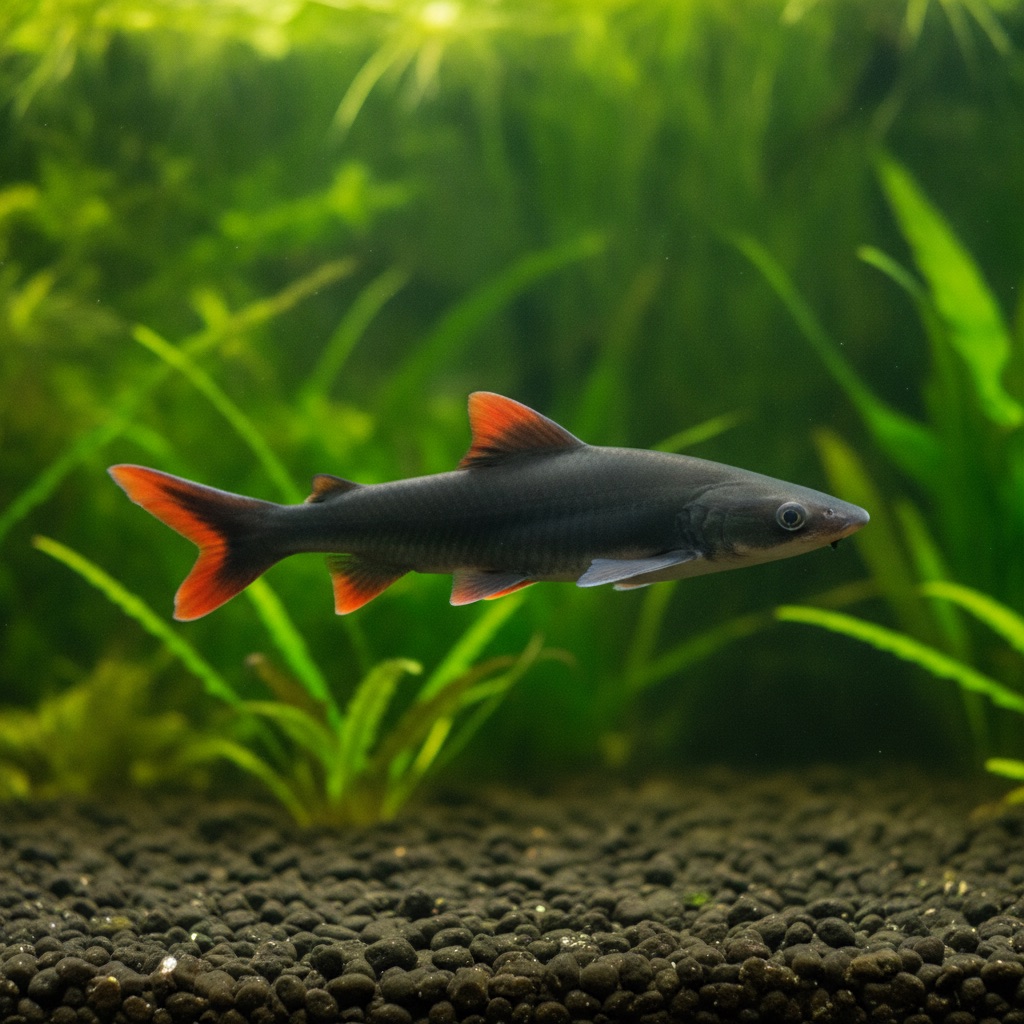
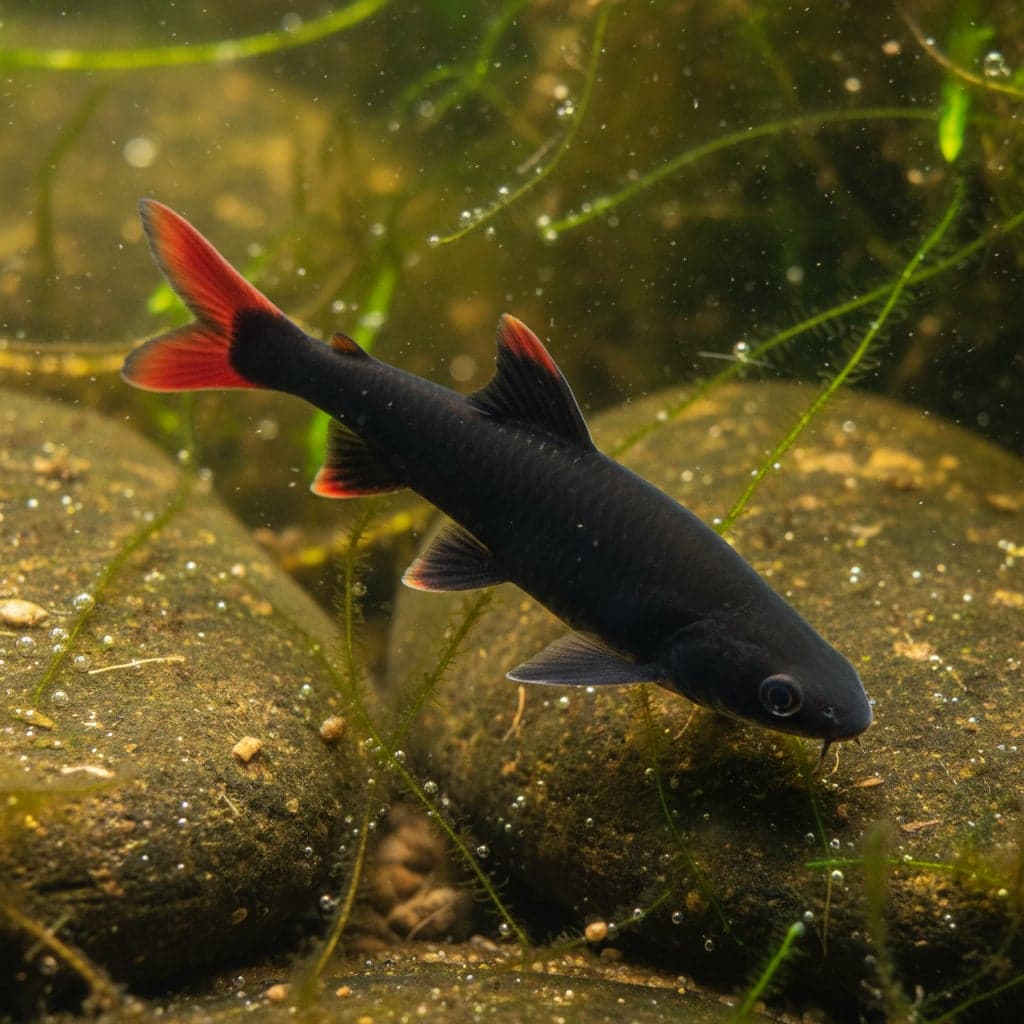
The Rainbow Shark is not a shark. It is a Southeast Asian cyprinid — a member of the carp and minnow family, closely related to barbs — and the name comes entirely from the tall triangular dorsal fin it holds erect when it is displaying. It is a genuinely handsome fish: a matte blue-black or charcoal body with scarlet fins, and a low, flat-bellied profile built for holding station on the bottom.
It is also the most consistently mis-sold fish in the freshwater trade. Shops stock them at 4-5 cm, at which size they are unremarkable and inoffensive, and sell them into 60- and 100-litre community tanks. They reach 15 cm, they become territorial somewhere between six months and a year old, and the aggression scales with the mismatch between the space they have and the space they want. Almost every "my rainbow shark turned nasty" story is a tank size story.
Natural Habitat & Origin
Epalzeorhynchos frenatum comes from the Mekong, Chao Phraya and Xe Bangfai basins across Thailand, Laos, Cambodia and Vietnam. It lives over sand and gravel in flowing water, moving into flooded margins during the wet season and retreating to the main channels as the water drops.
Its natural feeding mode explains its behaviour better than anything else. It is an aufwuchs grazer: it works over rock, wood and submerged surfaces scraping the mixed film of algae, biofilm, diatoms and small invertebrates that grows on them. That food source is fixed in place and finite, which is precisely the kind of resource an animal evolves to defend. A Rainbow Shark defending a cave and a patch of substrate in your tank is doing exactly what it does in a river — it is holding a feeding territory.
Wild populations have declined significantly through habitat modification, and the fish in shops are farmed rather than collected, produced in enormous numbers in Thai and Indonesian aquaculture.
Care Requirements
The tank is the whole of the difficulty with this species. Two hundred litres is the working minimum for one adult, and footprint matters more than volume — a 120 cm tank is far better than a tall 200-litre cube, because a territorial bottom fish needs horizontal distance to hold a territory that does not include the entire floor of the tank.
Water is easy: 24-27°C, pH 6.5-7.5, moderate hardness, well oxygenated with decent flow. They come from moving water and appreciate a current, though not a torrent.
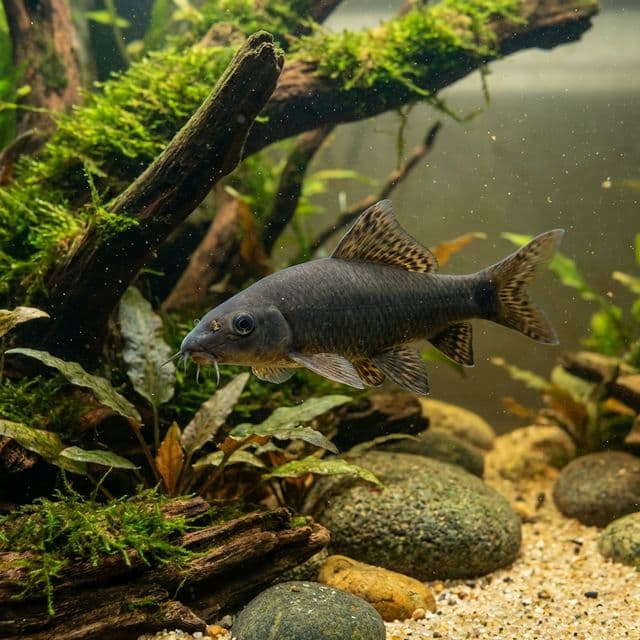
Layout is where you can actually reduce aggression, and it works. Break the floor into visually separate zones with rock, driftwood and planting, so that no fish can see the whole bottom from any one point. A shark that cannot see an intruder cannot chase it. Provide at least two caves — a length of pipe, a rock overhang, a hollow in the wood — because a shark with a retreat it considers safe patrols less than one that is still looking for one. Use sand or smooth fine gravel; they spend their lives in contact with the substrate and sharp gravel abrades the belly and barbels.
Fit a lid. Rainbow Sharks jump, particularly when newly introduced or when being chased, and a startled 15 cm fish clears an open rim easily.
Expect a lifespan of five to eight years. This is a long commitment in a large tank, not a starter fish, and the Intermediate difficulty rating on this page is about the housing rather than about water chemistry.
Use the Aquarium Tracker to log these parameters against your own readings — it flags a drift before it becomes a problem.
Diet & Feeding
An omnivore that leans herbivorous, and a fish routinely bought under a false premise. It grazes algae and it is not an algae eater in any useful sense: a juvenile will take soft green film off the glass, an adult largely stops bothering, and no Rainbow Shark will make a dent in black beard algae or hair algae. Buy it because you want the fish, not because you want a cleanup crew. If algae is the actual problem, a bristlenose pleco or a group of otocinclus is the honest answer.
Feed a proper varied diet: sinking pellets or wafers as the staple, a substantial vegetable component — blanched courgette, cucumber, spinach, spirulina-based foods — and frozen or live foods such as bloodworm, daphnia and brine shrimp two or three times a week. Underfed sharks graze harder, patrol more and get into more fights, so feeding properly is a behavioural intervention as much as a nutritional one.
Feed at the bottom, and feed late. They are most active in the evening, and food that reaches the substrate is food they get without having to compete with mid-water fish.
Behaviour & Temperament
Juveniles are shy and often hide for the first weeks. Somewhere between six months and a year, as they approach adult size, the temperament changes: the fish stakes out an area — typically a cave and the stretch of substrate around it — and begins driving other fish out of it.
What it attacks is specific, and understanding the pattern is the key to housing it. It targets fish of similar shape and habit: elongated, bottom-oriented fish that look like competitors for the same feeding territory. It largely ignores mid-water and surface fish that do not read as rivals. This is why a Rainbow Shark can be a menace to a catfish and completely indifferent to a shoal of rasboras in the same tank.
Towards its own species it is worse. Two Rainbow Sharks in anything short of a very large, heavily broken-up tank will fight persistently, and the loser does not simply concede — it is harassed continuously, stops feeding, hides, loses colour and dies. There is a widespread suggestion that keeping five or more "spreads the aggression", borrowed from cichlid keeping. It can work in tanks of several hundred litres with extremely complex hardscape, and it fails badly at the sizes most people actually have. The reliable advice is one per tank.
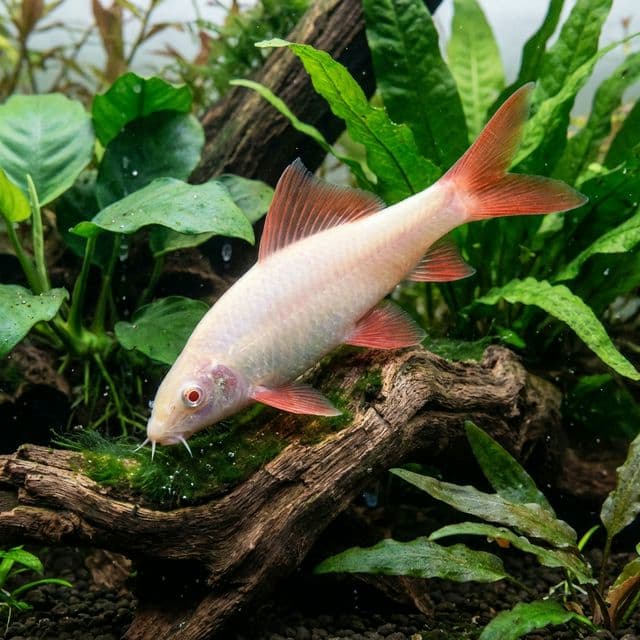
Colour is a useful indicator. A confident Rainbow Shark is near-black with bright red fins; one that has gone pale grey with washed-out fins is either being bullied, newly moved, or sick. The albino form, incidentally, is the same fish with the same temperament — it is not the calmer version, though it is often sold as though the difference in appearance implied a difference in behaviour.
Tank Mates
One Rainbow Shark, and nothing that looks like one.
Rule the following out entirely: another Rainbow Shark; the red-tailed black shark, which is the same genus and triggers the same response; the flying fox and Siamese algae eater, which are similar in shape and occupy the same niche; and larger loaches such as clown and yoyo, which will compete for the same caves.
Good tank mates occupy the water above it. Robust mid-water shoalers work well — tiger barbs and other active barbs, harlequin rasboras, larger tetras, danios and rainbowfish. They also act as dither fish, which measurably reduces skittishness in the shark.
Avoid slow, long-finned fish — angelfish, gouramis, fancy guppies — which get chased and cannot escape, and which present trailing fins that invite nipping. Corydoras and plecos are a judgement call: in 200 litres or more with plenty of cover they usually coexist, and in a small tank they get harassed continuously. Small dwarf shrimp will be eaten. Nerite snails and other large snails are generally ignored.
If a shark starts systematically hunting one particular tank mate, the situation does not resolve itself. Rehome one of them.
Breeding
Not something you will do at home. There are no reliable accounts of Rainbow Sharks spawning in a normal aquarium, and the reason is behavioural as much as environmental: the fish are aggressively intolerant of each other, so a pair cannot be maintained together long enough to condition and spawn.
Commercial production is done on farms in Southeast Asia using hormone induction, with the adults stripped and the eggs fertilised and incubated artificially. Every Rainbow Shark in a shop, including every albino, came from that process. It is worth knowing simply so you do not buy a second fish in the hope of a pair; what you will get is a fight.
Common Health Issues
Physically this is a hardy fish. It handles a wide range of conditions, resists most of the common freshwater diseases and is not fussy about chemistry. The problems it does get are mostly consequences of housing.
Chronic stress from inadequate space is the underlying issue behind most Rainbow Shark health complaints. It presents as persistent pale colouration, hiding, refusal to feed, and susceptibility to opportunistic infections that a comfortable fish would shrug off. A pale, hiding shark in a 100-litre community tank does not usually need medication; it needs a bigger tank or fewer rivals.
Fin damage from fighting is the other common one — split or shredded fins, usually on the loser of a territorial dispute. Clean water and separation resolve it; left in place, the damage progresses to fin rot as bacteria colonise the injury.
White spot turns up after temperature swings or a stressful move, as it does in any fish. Treat it, but treat it in a tank without invertebrates, or move the fish — copper-based treatments will kill any shrimp and snails present and the copper then leaches back out of the substrate for months afterwards. See medications.
The last thing to watch for is not a disease at all. Sharks are strong jumpers and the deaths that get recorded as "found dead, no symptoms" are frequently fish that jumped in the night. Keep the tank covered.