Species group

Rainbowfish Species: Why They Look Dull in the Shop

Rainbowfish are sold as juveniles before their colour develops, which is why they look grey in the shop tank. Which species to pick, and what they need to colour up.
Studio Scaped
Rainbowfish Species: Why They Look Dull in the Shop

The photograph problem

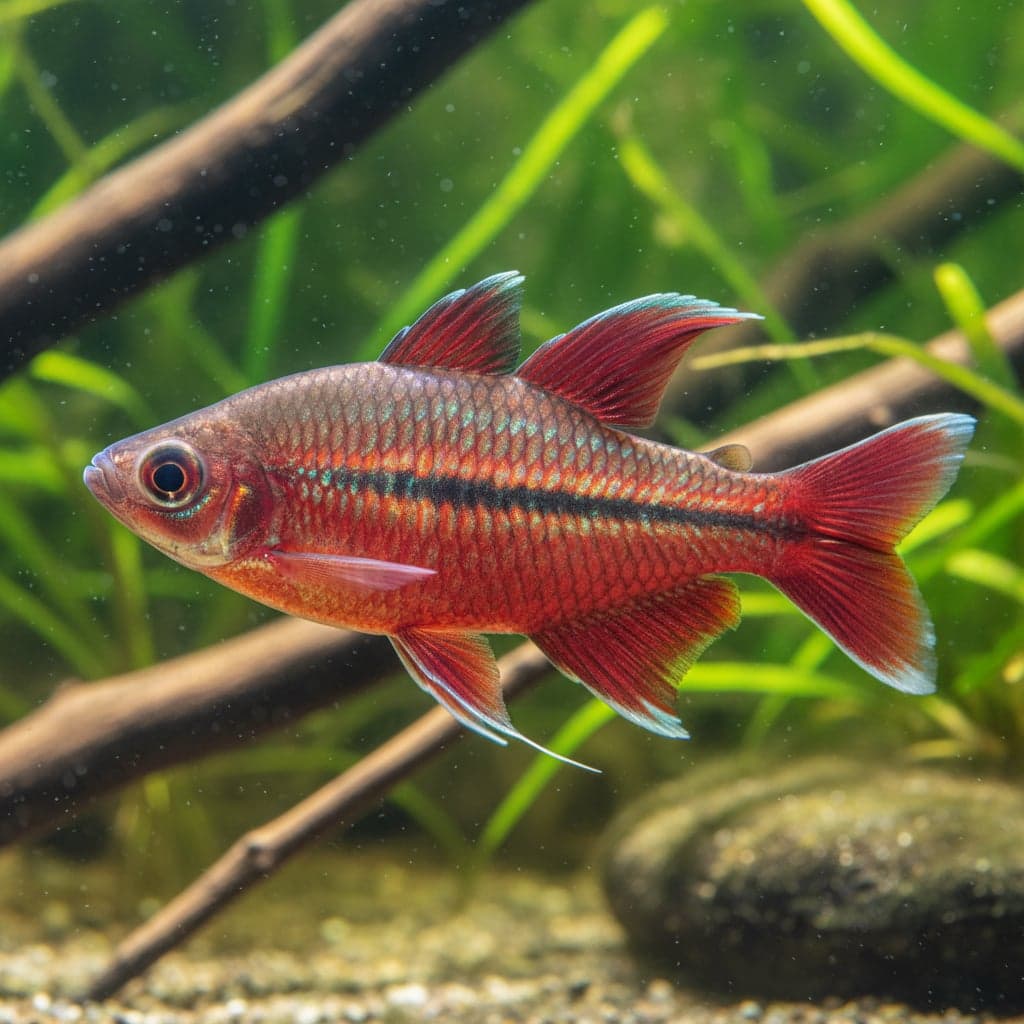
Rainbowfish have the widest gap in the hobby between what the fish looks like in the shop and what it looks like in two years. They are sold as juveniles, and juvenile rainbowfish are grey-silver with a hint of what is coming. The photographs that sell them are of mature males in breeding condition.

This costs the group sales it should win, and it also causes the most common disappointment: someone buys three, keeps them in a quiet tank, and the colour never arrives. Colour in rainbowfish is a function of maturity, of being in a group, and of having something to display against.

The species compared

SpeciesAdult sizeMin tankTemperatureTemperament
Neon Rainbowfish: Melanotaenia praecox4 cm—22-26°CPeaceful
Dwarf Rainbowfish: Melanotaenia maccullochi2.5-3 inches (6-7 cm)—22-26°CPeaceful
Red Rainbowfish: Glossolepis incisus12-15 cm—24-28°CPeaceful
Celebes Rainbowfish: Marosatherina ladigesi3 inches (7-8 cm)—22-28°CPeaceful
Yellow Rainbowfish: Melanotaenia herbertaxelrodi3.5-4.5 inches (9-11 cm)—22-28°CPeaceful
Sunset Dwarf Rainbowfish: Melanotaenia parva2-2.5 inches (5-6 cm)—22-26°CPeaceful
Bleher's Rainbowfish: Chilatherina bleheri10-12 cm—24-28°CPeaceful
Wapoga Red Laser Rainbowfish: Melanotaenia rubrivittata3.5-4.5 inches (9-11 cm)—24-28°CPeaceful
Exquisite Rainbowfish: Melanotaenia exquisita3-4 inches (8-10 cm)—22-28°CPeaceful
Black-banded Rainbowfish: Melanotaenia nigrans10 cm (4 inches)—24-28°CPeaceful
Susi Creek Rainbowfish: Melanotaenia susia6-8 cm—22-26°CPeaceful
Lake Wanam Rainbowfish: Glossolepis wanamensisGlossolepis wanamensis10cm150L24-28°CPeaceful / Active
Aru Rainbowfish: Melanotaenia picta4-5 inches (10-12 cm)—22-26°CPeaceful
Parkinson's Rainbowfish: Melanotaenia parkinsoni10-12 cm (4-5 inches)—24-28°CPeaceful
Lake Kutubu Rainbow: Melanotaenia lacustrisMelanotaenia lacustris12cm150L20-25°CPeaceful / Active
Fly River Rainbowfish: Melanotaenia sexlineata10 cm (4 inches)—22-28°CPeaceful
Murray River Rainbowfish: Melanotaenia fluviatilis9-10 cm (3.5-4 inches)—18-25°CPeaceful
Western Rainbowfish: Melanotaenia australis9-11 cm—22-26°CPeaceful
Melanotaenia splendida rubrostriata: Red-striped Rainbowfish4-5 inches (10-12 cm)—24-28°CPeaceful
Kamaka Rainbowfish: Melanotaenia kamakaMelanotaenia kamaka8cm100L24-28°CPeaceful
Melanotaenia x Glossolepis hybrid: Crossing Rainbowfish10-12 cm—22-28°CPeaceful
Forktail Rainbowfish: Pseudomugil furcatus5 cm (2 inches)—24-28°CPeaceful
Tami River Rainbowfish: Glossolepis pseudoincisa3-4 inches (8-10 cm)—24-28°CPeaceful

Reading that table

Size is the first filter, and length is the real constraint. The dwarf species stay around 5-7cm; the larger Melanotaenia reach 10-12cm and are strong, constant swimmers. For this group the footprint of the tank matters more than its volume — a long tank of modest depth suits them better than a tall one holding the same litres.

Not everything called a rainbowfish is closely related. The Celebes rainbowfish comes from Sulawesi rather than Australia and New Guinea, and the forktail is a blue-eye rather than a Melanotaenia. They are grouped by appearance and by trade convention, so check the individual profile rather than assuming the water and the adult size carry across the group.

They are hard-water fish more often than not. Many of the Australian and New Guinean species come from neutral to alkaline water, which puts them at odds with the soft-water tetras and rasboras they are often stocked alongside. It is not usually fatal — they are adaptable — but it is worth checking against your tap water before committing.

Getting them to colour up

Four things, in rough order of effect:

Keep enough of them. Six is a floor, not a target. Males colour when they have rivals, and a single male in a peaceful tank has no reason to.

Give them time. Full colour takes months, sometimes more than a year in the larger species. The fish you bought is not the fish you will have.

Feed properly. Varied food, including live or frozen, shows in the colour of this group more visibly than in most.

Give them a dark substrate and some plants. Rainbowfish wash out over bright gravel, and the contrast of a planted tank does half the work before the fish has done anything.

Where to start

The dwarf neon and the Boesemani-type species are the usual entry points: widely available, hardy, and colourful enough at a size that suits a normal community tank. The Celebes rainbowfish is the outlier worth knowing about — smaller, more delicate, and a different fish from the rest of this list.

Individual profiles below cover parameters, sexing and breeding for each species.
Common questions

Why are my rainbowfish not colourful?
Most likely they are juveniles. Rainbowfish are usually sold before they colour up, and the adult colour develops over months as the fish matures. A settled group in a planted tank with good food will look nothing like the fish you carried home.
How many rainbowfish should I keep together?
They are shoaling fish and are kept in groups — six is the usual minimum and more is better. A group also brings out the colour, because males display against each other.
What size tank do rainbowfish need?
Length matters more than volume for this group. They are active, open-water swimmers, and the medium and large species need a tank they can actually move in rather than a tall one with the same capacity.
Are rainbowfish peaceful?
Generally yes. They are active and can be boisterous enough to unsettle very shy tank mates, and males display at each other, but they are not aggressive in the way a territorial cichlid is.

Sources

External references used when checking this species' care parameters.

More Fish Groups

ADA
Aqua One
Chihiros
Dennerle
EHEIM
Fluval
Oase
Seachem
Tropica
Twinstar
UNS
ADA
Aqua One
Chihiros
Dennerle
EHEIM
Fluval
Oase
Seachem
Tropica
Twinstar
UNS
ADA
Aqua One
Chihiros
Dennerle
EHEIM
Fluval
Oase
Seachem
Tropica
Twinstar
UNS
ADA
Aqua One
Chihiros
Dennerle
EHEIM
Fluval
Oase
Seachem
Tropica
Twinstar
UNS