Pufferfish Species: Freshwater, Brackish and Marine
Most pufferfish sold as freshwater are not. Which species are genuinely freshwater, how big each gets, and why every puffer needs hard-shelled food.
The freshwater problem
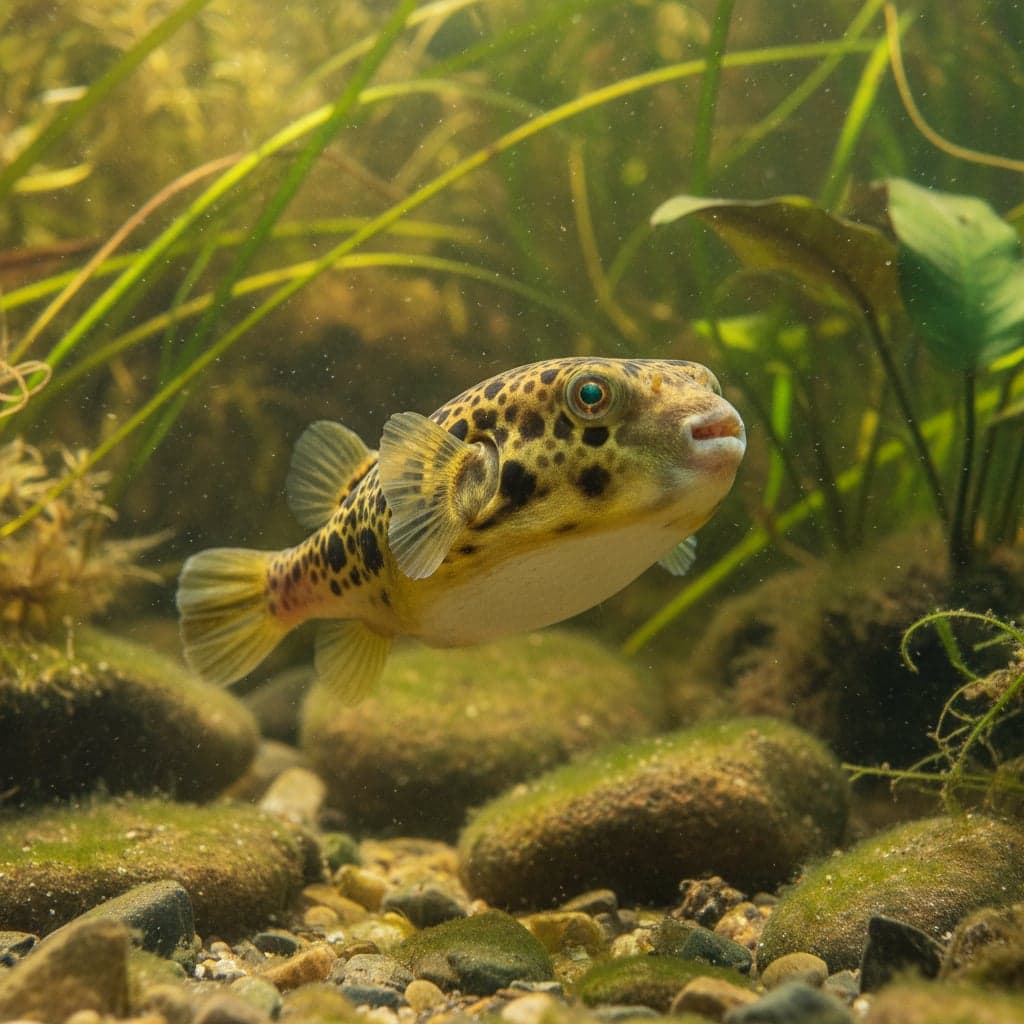
Pufferfish are sold as freshwater fish far more often than they are freshwater fish. The green spotted puffer is the usual example: it is stocked in freshwater tanks, lives for a while, and declines slowly in a way that is easy to blame on something else. It is a brackish species that moves toward full marine conditions as it matures.
So the first question about any puffer is not how big it gets. It is which water it actually needs.
Every puffer kept in aquaria, by water type
Freshwater
| Species | Adult size | Min tank | Temperature | Temperament |
|---|---|---|---|---|
| The Pea Puffer: Carinotetraodon travancoricus | 2-3 cm | — | 24-28°C | Aggressive |
| The Spotted Congo Puffer: Tetraodon schoutedeni | 3-4 inches (8-10 cm) | — | 24-26°C | Peaceful / Semi-Aggressive |
| South American Puffer: Colomesus asellus | 3-3.5 inches (8-9 cm) | — | 24-28°C | Semi-Aggressive |
| The Red Eyed Puffer: Carinotetraodon lorteti | 2.5 inches (6 cm) | — | 24-28°C | Aggressive |
| Red Tailed Red Eyed Puffer: Carinotetraodon irrubesco | 4-5 cm | — | 24-28°C | Semi-Aggressive |
| Fang's Puffer: Pao cochinchinensis | 3-4 inches (8-10 cm) | — | 24-28°C | Aggressive |
| Bronze Puffer: Auriglobus modestus | 10 cm (4 inches) | — | 24-28°C | Aggressive |
| Pignose Puffer: Pao suvattii | 5-6 inches (12-15 cm) | — | 24-28°C | Predatory (Ambush) |
| Topaz Puffer: Dichotomyctere fluviatilis | 6-7 inches (15-18 cm) | — | 24-28°C | Aggressive |
| Potato Puffer: Tetraodon miurus | 12-15 cm (5-6 inches) | — | 24-28°C | Predatory (Ambush) |
| Humpback Puffer: Pao palembangensisPao palembangensis | 20cm | 150L | 24-28°C | Aggressive |
| Hairy PufferPao baileyi | 15cm | 120L | 24-28°C | Aggressive |
| Fahaka Puffer: Tetraodon lineatus | 16-18 inches (40-45 cm) | — | 24-28°C | Aggressive |
| The Mbu Puffer: Tetraodon mbu | 60-75 cm (24-30 inches) | — | 24-28°C | Aggressive / Interactive |
Brackish / Marine
| Species | Adult size | Min tank | Temperature | Temperament |
|---|---|---|---|---|
| Green Spotted PufferDichotomyctere nigroviridis | 15cm | 120L | 24-28°C | Aggressive |
| Peacock Fugu Puffer: Takifugu rubripes | 15 cm (6 inches) | — | 22-27°C | Aggressive |
Brackish
| Species | Adult size | Min tank | Temperature | Temperament |
|---|---|---|---|---|
| The Figure of Eight Puffer: Dichotomyctere biocellatus | 3 inches (8 cm) | — | 22-26°C | Semi-Aggressive |
Saltwater
| Species | Adult size | Min tank | Temperature | Temperament |
|---|---|---|---|---|
| Valentini Puffer (Saddled Toby): Canthigaster valentini | 3-4 inches | — | 24-27°C | Semi-Aggressive |
| Jewel Pufferfish: Canthigaster solandriCanthigaster solandri | 12cm | 150L | 24-27°C | Semi-Aggressive |
| Pacific Crowned PufferfishCanthigaster axiologus | 10cm | 115L | 24-26°C | Semi-aggressive |
| Bennett's Sharpnose PufferfishCanthigaster bennetti | — | 120L | 24-26°C | Semi-aggressive |
| Porcupine PufferfishDiodon holocanthus | — | 900L | 24-26°C | Semi-aggressive |
| Whitespotted PufferfishArothron hispidus | — | 1500L | 24-26°C | Semi-aggressive |
What the table does not show
Adult size is the second trap. The group runs from the pea puffer at 2-3cm to the mbu at 60-75cm. Those are not variations on a theme — the mbu is a fish that outgrows most domestic tanks and needs a volume measured in thousands of litres. Several of the mid-sized species sold as manageable reach 15-20cm and are territorial at that size.
The teeth are a husbandry requirement. A puffer's beak grows continuously and is worn down in the wild by crushing shells. On a diet of soft or prepared food it overgrows until the fish cannot eat, and correcting that means anaesthetising the fish and trimming it. The fix is preventive: snails, and other hard-shelled foods, routinely. If you keep puffers you will end up culturing snails, which is worth knowing before rather than after.
They are not community fish. Puffers nip fins, and the larger species eat what fits. Most are kept alone or in a species tank. The small ones are not exempt — a pea puffer is a predator scaled down, not a peaceful nano fish.
Skip the "puffing" question. A puffer inflating is a stress response, not a trick. Doing it out of water can force air into the fish and is genuinely harmful.
Choosing one
If you want a puffer in a small tank, the pea puffer is the only realistic option, and it still needs a snail supply and ideally a species tank. In the mid range the Congo puffers and the South American puffer are genuine freshwater species with real personality at a size a normal aquarium can accommodate. The large Tetraodon — fahaka, mbu — are specialist fish for people building around them.
If the fish you are drawn to is in the brackish or marine rows above, treat that as the starting constraint and plan the salinity before the tank.